
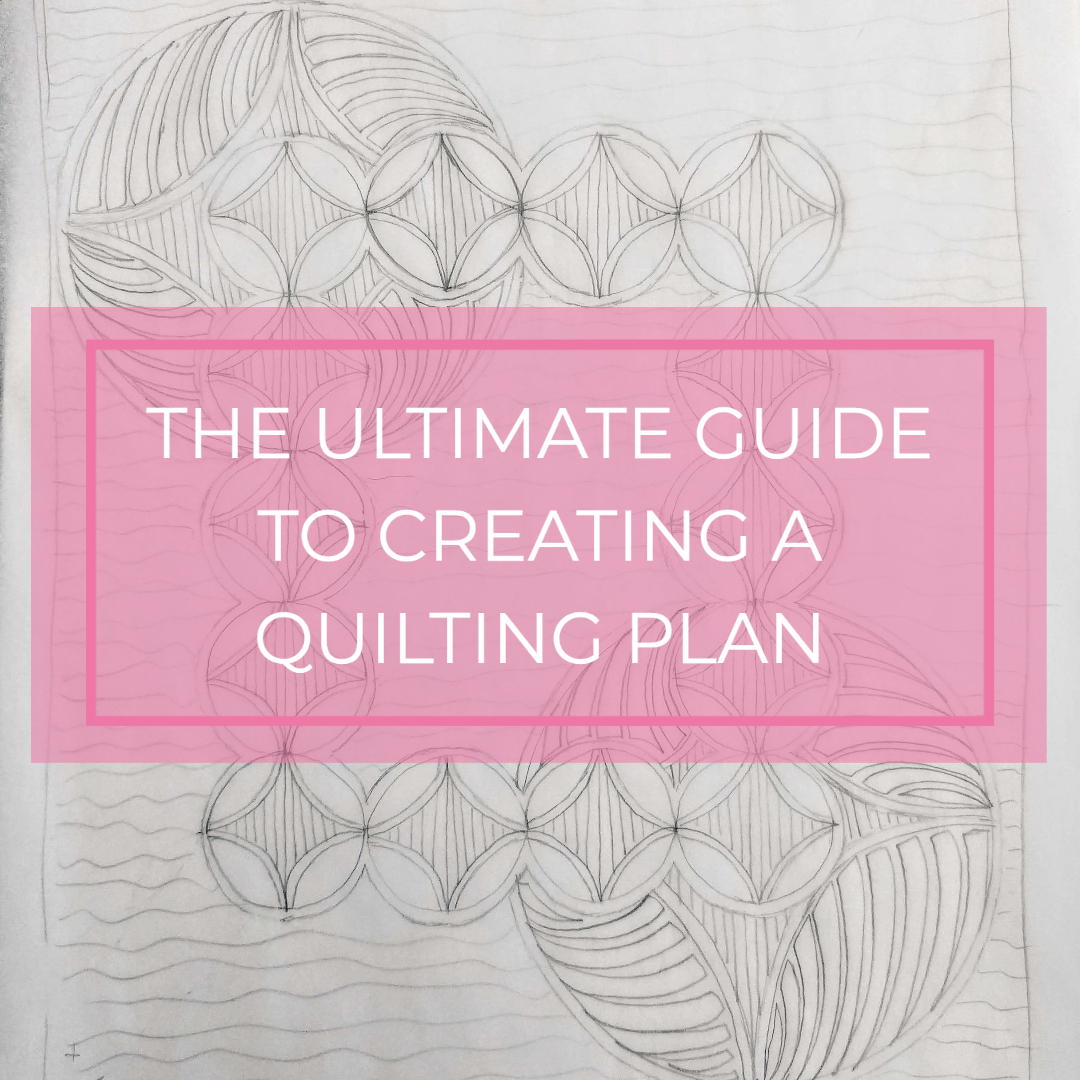

I honestly didn't realize that I had such a concrete way of creating my quilting plans until I started a little project called Simone's Design Sessions in 2019. This is where I helped my newsletter subscribers with quilting plans when they felt stuck. I realized that with every design session and with every personal quilt, I was following a very specific method that I had come up with over time and works best for me.
Unfortunately, I quickly realized that I couldn't meet with everyone on every quilt top for the rest of my life. The next best thing would be a written guide where I could teach you my process and you could develop your own quilting plans! So here we are! This guide will help you start every quilt with confidence.
A few notes before we begin:
- The steps in this guide build upon themselves. It's important to carefully consider each step before moving on to the next one.
- Most of my experience is on a longarm, so step four has a note on how I personally tackle that step on my longarm.
- There are some bonus tips at the end that I find helpful and think you will too!
To help see this process in action, I encourage you to have a real quilt top ready and apply each step as you build a quilting plan specifically for that quilt top.
Step 1: Define what your background will be
Most quilts have a definitive background. This is usually a neutral color that allows the piecing of certain blocks to take center stage. And by neutral color, I do not necessarily mean white! Neutral just means a color that plays happily with the others without being overpowering.
You can handle your background in a few different ways:
- Quilt it densely so that it is physically less pronounced than the foreground.
- Quilt it the same density as the foreground but with a repeating pattern so it is easily identifiable throughout the quilt as the background.
- Create your own secondary design shapes/ghost shapes - shapes that are replicas or have similar features of the pieced blocks. (more on secondary designs further on!)
- Create a unique background area that may or may not align with seam lines (more on this further on as well!)
An exception to this is scrappy quilts. It is hard to define the background for quilts that have a lot of piecing throughout, colors of similar value, and that are meant to be enjoyed as a whole instead of broken down by quilting.
Step 2: Find basic or recognizable shapes
A foundational step in learning free motion quilting is finding the best motif for common shapes. It helps you learn how to navigate in and around these shapes and you become more comfortable and confident when free motion quilting.
Common shapes found in quilts are squares, triangles, and circles. There are variations of these, like rectangles, diamonds, and ovals but they can be treated in the same way.
Sometimes it can be hard to find a recognizable shape because of the piecing seams or fabric placement in a block.
For example, a trapezoid shape. That is not a “basic” shape! But if you break it down, it is a triangle next to a square next to another triangle. If you're most comfortable quilting within these shapes, break up that trapezoid! Quilt each shape within that block and you will get a neat design.
Another example is a diamond. That's two triangles! Define the triangle shapes and then quilt a design you like in them. This will create a unique look.
Here is an example of how to break up a traditional quilt block into these basic shapes.
Changing the way you see blocks to find recognizable basic shapes helps when feeling overwhelmed by all the quilt block designs in the world. Thinking this way makes any quilt top feel manageable!
Step 3: Decide on keeping quilting within the basic shapes/seams or combining them into secondary designs
This step is a combination of some of the options listed in steps 1 and 2.
If you would like to enter the world of secondary design, this is when you decide to do it!
Sometimes a quilt top just demands an extra level of design. You see that certain fabrics are placed near each other in separate blocks but you can see the potential to combine them into something special.
You can span from one section of a block to another next to it, quilting a defining outline across the background fabric to create the shape you see in your mind's eye.
Depending on the design, you can repeat this shape throughout the top or isolate it in certain areas. This just depends on how much you love the person you are gifting it to, heh. I do think that creating these designs is almost always worth that extra effort.
If this seems like too much, don't worry! Your decision is made. Work within the seam lines for equally beautiful results. Honoring the seam lines of a block has the effect of letting those block designs shine.
There's really no wrong choice here, just personal preference.
Step 4: Break up the quilt into manageable chunks
So far you've made some major decisions on your quilting plan. You're feeling good about your choices and you're ready to get quilting! Well hooooold on! We're not done quite yet.
This next step is where quilting on a longarm or domestic machine is important.
On a longarm, you have the ability to see a large horizontal chunk of the quilt top but because of the way it is loaded, you don't have the luxury of working on just any spot you want. So at this point, you need to decide on quilting both the background and foreground of the quilt as you make your way down, or start with one or the other but have a good basting plan in place.
Personally, I like to start with stitching in the ditch along all of the blocks (being careful to only do this in the outline of the blocks I am keeping as a unit or outlining my secondary designs) and then I focus on filling in the background, basting the edges and any large unquilted areas on my way down the quilt as I go. Then I roll my way back up to the top and focus on the blocks. Quilting this way also allows me to change thread only a few times to match colors of each section whereas quilting the entire quilt top in one shot may require multiple thread changes with every roll of the quilt.
On a domestic, your quilt sandwich is all basted and you can start pretty much anywhere. Conventional wisdom states to start in the middle but I have heard lessons from many a successful domestic machine quilter that teaches starting from the edges and working your way in. Just make sure you know how big of a chunk you can work at a time, and how you are going to get around the entire quilt top. Thread changes should also be part of your plan.
If you are quilting large negative spaces, it is helpful to break them up into manageable chunks. You can do this by creating secondary designs or changing motifs.
In the example below, I have broken up the negative space by creating a flying geese pattern between the dogs, and I added a feather motif weaving throughout the top to create some layering/dimension.
If you choose not to break up the negative space, have a plan on how you will come to a stop when you need to advance your quilt or move to a different section. I prefer to quilt off the edge or on a seam line before advancing my quilt tops on my longarm so I will always make sure to make my way there when I am getting close to completing a section.
Knowing how you are going to navigate the quilt top ahead of time will prepare you to execute your free motion quilting plans without having to worry about the logistics of getting around while you are doing it. Let's only worry about one thing at a time!
Step 5: Choose which designs you are going to use…but limit yourself
You are SO close! Your quilting plan is almost complete. This is probably my favorite part of the whole process! I love coming up with the different quilting motifs I am going to use on a quilt top.
Take all the decisions you have made up to this point to help in making this decision:
- What will your background motif be?
- What basic shapes are in the quilt top? What motifs look amazing in them? Which ones are you most comfortable with?
- Will there be any secondary designs? Which motifs will be in both the blocks and these secondary designs?
- How easy is it to go from one motif to another? Will you need a ruler plate and rulers? Will you be switching thread in each section?
I noticed early on in my free motion quilting adventures that I wanted to use every single motif I knew. I wanted to put all kinds of texture on my quilts. So I did. And boy, lemme tell ya, they were STIFF. Not just stiff but…ugly. Yes, ugly. They took over the quilt pattern design and there was no unity, no theme, no finesse. So I learned that in order to get the truly beautiful compliment to the design that I wanted, I had to limit my motifs.
What that magic number is dependent on the top itself. Some sampler quilts can handle quite a few motifs, and those are so much fun to quilt! Even so, I suggest repeating some motifs to create unity in a quilt top that can look scattered if you're not careful. Often repeating fabrics can help you choose which repeating motifs to use and where. Other quilts, like those with rows of repeating blocks, may call for just two, a background motif and a block motif.
Bonus tips
- Print out a photo or outline diagram of the quilt top so you can draw your motifs directly on it. Or use tracing paper over your print out and try different designs on different pieces of tracing paper. This will give you a good idea of what your final quilt will look like! *Brownie points if you stretch your creative muscles and come up with more than one quilting plan with these tracing papers!
- Practice your motifs on paper (or tablet if you're feeling fancy), especially using the basic shapes you identified in step two. Do this A LOT until you are confident in how you will navigate those shapes.
- Practice each motif on a sample sandwich off to the side before you get started on your quilt top. This is especially helpful if you go long periods of time in between projects. This will help you get the feel for free motion quilting again and you can make adjustments to your thread tension at the same time, if needed. Two for one! 🙂
So what do you think? Do you find this helpful? Let me know your thoughts in the comments below! Feel free to post any questions, too!
Happy quilting!
Simone
Wow! Lots to think about. A wonderful reference. Thank you!
I'm so glad you found it helpful! Let me know of you ever have any questions ?
Extremely helpful to me as a beginner with free motion quilting - thank you so much!
Awesome! That is exactly what I was hoping for ?. Let me know if you have any questions!